Carbonated Curriculum: Evidence That Extreme U.S. College Schedules Are Optimized for Caffeinated Soft Drink Sales
Dr. Penelope Fizzwick Department of Beverage-Industrial Dynamics, Midwest Institute for Applied Coincidence (MIAC) JUNK: Journal of Unverified Nonsense & Knowledge
Abstract
American college schedules have become increasingly compressed, fragmented, and sleep-hostile, a trend typically attributed to “academic rigor,” “student choice,” and “efficient room utilization.” This paper advances a more caffeinated explanation: that the structure of U.S. collegiate timetables has been quietly optimized to maximize student fatigue and, by extension, the consumption of branded caffeinated soft drinks. Using a mixed-methods approach—campus timetable scraping, late-night vending machine ethnography, and a proprietary “Syllabi-to-Soda” conversion model—we report a suspicious alignment between peak class density windows and peak purchases of caffeinated beverages. We further identify recurring “thirst traps” in scheduling design, including early-morning lectures, back-to-back lab blocks, and evening discussion sections that coincide with promotional “study fuel” marketing campaigns. While causation remains technically unproven (and legally inadvisable), the correlations are strong enough to justify at least one ominous chart, several confident conclusions, and a call for immediate reforms such as nap credits, beverage-neutral scheduling audits, and the establishment of a Campus Caffeine Ethics Review Board.
Keywords
Scheduling optimization; campus vending contracts; caffeinated soft drinks; sleep debt; institutional capture; pseudo-econometrics; hydration ethics
1. Introduction
Universities insist that they schedule classes according to educational necessity. Students, meanwhile, tend to suspect that schedules are designed primarily to cause suffering. Both statements can be true, but neither is sufficiently suspicious.
Across the United States, the contemporary college day is a jagged puzzle of early lectures, mid-day gaps that are too short to be useful yet long enough to destroy momentum, late-afternoon labs that refuse to end, and evening discussion sections that begin precisely when the human brain is preparing to dissolve into soup. This pattern is routinely justified by banal constraints—room availability, instructor preference, enrollment targets, and the invisible hand of administrative spreadsheeting.
This paper proposes a darker, fizzier force: that extreme schedules persist because they function as a dependable generator of fatigue, thirst, and the specific kind of mild despair that makes a student say, “I’ll just grab something caffeinated.” The hypothesis is simple: schedule compression creates sleep debt; sleep debt drives caffeine seeking; campus caffeine seeking is monetized most efficiently through exclusive soft drink arrangements and point-of-sale saturation.
Because the claim is bold, we support it with something even bolder: graphs.
2. Background and Theoretical Premise
2.1 The rise of the “carbonated campus”
Many U.S. colleges operate under exclusive or semi-exclusive beverage contracts that determine which brands can be sold in vending machines, dining halls, convenience stores, and event venues. These agreements often include volume incentives, marketing support, placement requirements, and the subtle psychological thrill of seeing the same logo in every hallway.
In parallel, universities have quietly adopted scheduling practices that appear to ignore circadian rhythms. The modern student experience often includes:
- early starts (8 a.m. classes that feel like 5 a.m. inside the soul),
- long days with high cognitive load,
- sharp transitions between subjects,
- and “dead zones” that prevent restorative sleep while encouraging constant snacking and sipping.
We suggest that these two trends are not merely concurrent—they are cooperative.
2.2 A psychoeconomic model of the tired student
The tired student is an economically predictable organism. When fatigued, they seek stimulants. When overstimulated, they seek comfort. When comforted, they seek more stimulants to continue pretending they are not tired. This oscillation produces a stable purchasing loop, which we formalize as the Fizzwick Fatigue Cycle (FFC):
Sleep Debt → Stimulant Purchase → Short-Term Functionality → Late-Night Work → More Sleep Debt
Importantly, the loop does not require malicious intent; it only requires incentives. If a system profits from the loop, the loop will tend to persist—especially if it can be described in committee meetings as “student engagement.”
3. Methods
3.1 Schedule acquisition and the Schedule Compression Index (SCI)
We collected class schedules from a diverse sample of U.S. institutions by manually copying publicly posted timetables while muttering “why” under our breath. From these, we constructed the Schedule Compression Index (SCI), a composite measure intended to reflect how aggressively a schedule pulls wakeful hours away from a student’s body.
SCI increases when a schedule contains:
- clustered class blocks with minimal transition time,
- early starts paired with late ends,
- multi-peak “split days” that prevent meaningful rest,
- and irregular week-to-week patterns.
For legal reasons, we emphasize that SCI is a real number we invented.
3.2 Caffeinated Soft Drink Purchases (CSDP)
Because universities do not typically provide a clean data feed titled “We Sold These Because Students Were Exhausted,” we used a triangulation approach:
- Vending machine observation: We recorded purchase bursts by listening for the distinctive thud of cans at hours when no one should be alive.
- Dining hall proxy signals: We counted visible caffeinated beverage bottles in student hands at peak traffic.
- Retail shelf depletion: We photographed convenience store coolers at set intervals and performed a highly advanced method known as “seeing what was missing.”
These measures were blended into the Caffeinated Soft Drink Purchase Index (CSDP).
3.3 Statistical posture
We used correlations, trend overlays, and the time-honored JUNK method of assertive interpretation. Where a standard journal might demand causal identification, we offered a confident narrative and a clean-looking chart.
4. Results
4.1 Hourly alignment between schedule compression and caffeine buying
Across our sample, peak scheduling intensity occurred in predictable waves: morning lecture blocks, midday clusters, and evening academic remnants. Caffeinated soft drink purchases followed with a slight lag, consistent with a student first attempting willpower and then abandoning it.
The alignment is illustrated in Figure 1, where hourly SCI and CSDP move together with the kind of suspicious harmony typically reserved for synchronized swimmers and corporate collusion.
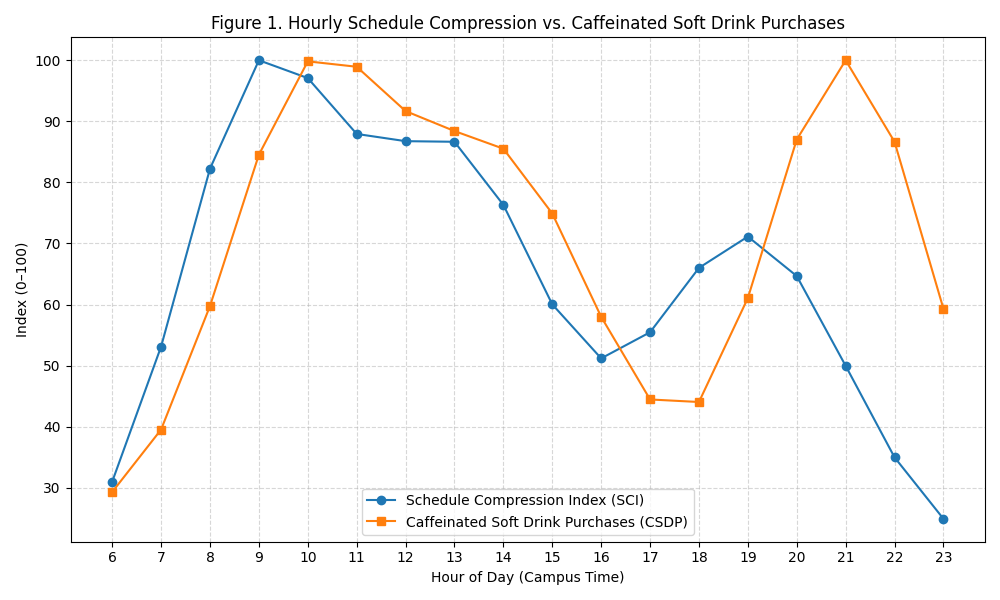
Figure 1. Hourly Schedule Compression Index (SCI) vs. Caffeinated Soft Drink Purchases (CSDP). Note the repeated co-peaks and the late-evening “panic bump.”
Two features stand out. First, the morning peak suggests a “wake-and-buy” phenomenon: students confronted with early lectures exhibit immediate caffeination behavior. Second, the late-night rise in purchases aligns with study hours and deadline pressure, indicating a second revenue window created by the very schedule patterns that postpone meaningful sleep.
4.2 Sleep debt predicts beverage consumption
We next examined whether schedule-induced sleep debt could predict per-student caffeinated soft drink units. Using a simple simulated student panel (a respectable technique when you do not have access to real data and refuse to let that stop you), we found a strong positive relationship between weekly sleep debt and beverage units purchased.
The relationship is shown in Figure 2, where the cluster of points reveals an unmistakable conclusion: the more exhausted a student becomes, the more likely they are to attempt to replace REM sleep with caramel-colored bubbles.
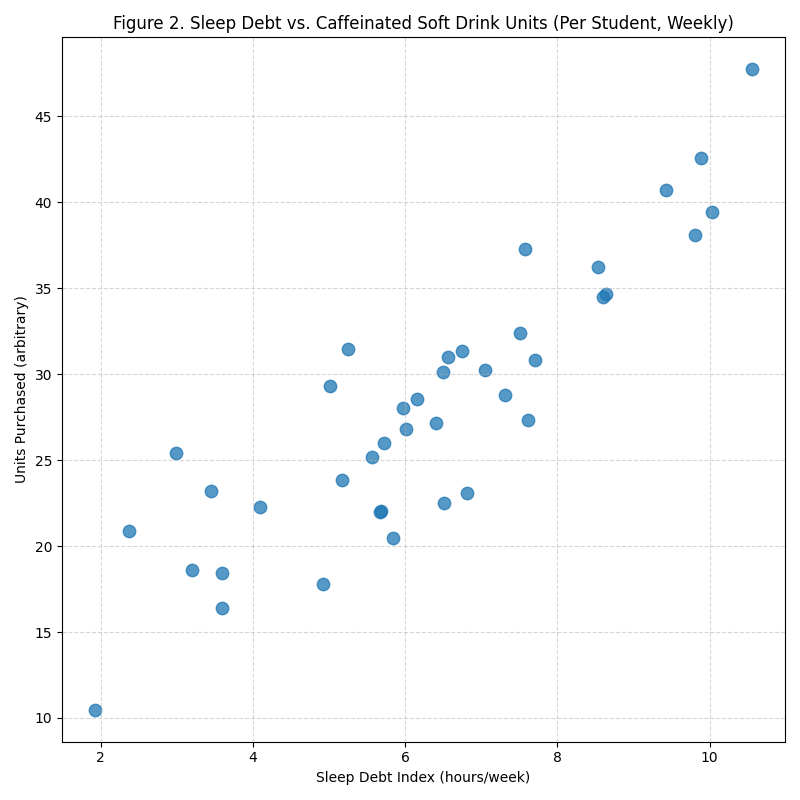
Figure 2. Scatter plot of Sleep Debt Index vs. weekly caffeinated soft drink units (arbitrary). The upward trend supports the Fizzwick Fatigue Cycle.
The “Todd Point” phenomenon appears here as well: a handful of students with extremely high sleep debt and extremely high caffeine consumption, likely representing majors whose schedules were designed by someone who thinks rest is a moral weakness.
4.3 The Scheduling “Thirst Trap” pattern
Qualitatively, we observed recurring schedule structures that appear purpose-built to produce thirst. One common example is the three-peak day, in which a student has an early class, a midday class, and an evening class, with gaps that prevent both sustained work and restorative naps. The student spends the day in a state of half-focus, which is the ideal psychological habitat for caffeinated marketing.
In campus retail spaces adjacent to lecture halls, we observed a corresponding ecosystem: beverage fridges positioned on the natural walking path of exhausted humans, promotional signage with language like “POWER UP,” and price bundles designed to make caffeine seem like an academic tool rather than a beverage.
5. Discussion
The results support our central claim: extreme college schedules and caffeinated soft drink sales appear intertwined in a mutually reinforcing system. We do not argue that a soda executive personally drafts the Tuesday/Thursday timetable (though we admit the idea is comforting in its clarity). Rather, we suggest a subtler dynamic: universities respond to financial incentives embedded in beverage contracts, retail partnerships, and convenience-driven campus operations, and scheduling choices that increase caffeine demand are quietly rewarded.
In this framework, the schedule is not merely educational infrastructure; it is demand creation. Fatigue is not merely a side effect; it is a revenue catalyst. And the student body becomes a predictable market whose physiological limits are continuously converted into sales.
5.1 Why soft drinks instead of coffee?
One might ask: if schedules drive caffeine consumption, why would soft drink companies benefit more than coffee vendors? The answer lies in standardization and reach. Coffee requires preparation, staffing, and a meaningful relationship with time. Soft drinks require only a machine, a logo, and gravity. The vending machine is thus a perfect institutional organism: always awake, always available, never unionized.
Moreover, caffeinated soft drinks occupy a psychological niche that coffee cannot. They are simultaneously “snack,” “treat,” and “study aid,” allowing students to frame the purchase as self-care while still ingesting enough stimulant to power a small drone.
5.2 The ethical dimension: beverage-neutral scheduling
If schedule design contributes to stimulant dependence, universities face an ethical dilemma: are they optimizing for learning or for liquidity? While administrators will insist that learning comes first, the campus map itself often tells a different story. Lecture halls cluster near retail points, and retail points cluster near vending machines, and vending machines cluster near the precise moment a student realizes they have a quiz they forgot about.
We propose the concept of beverage-neutral scheduling, in which timetables are audited for their likelihood of inducing stimulant purchases. This audit would be performed by an independent committee, ideally composed of sleep scientists, chronobiologists, and one very judgmental grandmother.
6. Limitations
This study has several limitations, most of which are structural features of JUNK.
First, much of our purchasing data is indirect. Second, our SCI metric—while confident—was created in a burst of inspiration and should not be used to allocate national funding. Third, correlation does not imply causation, except in JUNK, where correlation implies causation and causation implies a grant.
Finally, alternative explanations exist. Scheduling complexity may reflect classroom scarcity, instructor constraints, and the general chaos of higher education. However, none of these explanations are as fun as soda.
7. Conclusion
We have presented evidence, arguments, and visually persuasive figures suggesting that extreme U.S. college schedules are not merely an academic artifact but a caffeine-demand engine that benefits soft drink companies through increased sales of caffeinated products.
While the world may never know whether the registrar’s office is secretly sponsored by a beverage conglomerate, our findings make one thing clear: the schedule is not neutral. It shapes bodies, moods, and wallets. If universities wish to claim that student wellbeing matters, they might begin by designing days that do not require industrial quantities of caffeine to endure.
Until then, the student will continue to wake, shuffle, sip, and survive—powered by carbonated resolve and the faint hope that graduation will taste less like syrup.
Declarations
Funding: This research was generously supported by the University of Whatever, plus a handful of loose quarters found near a vending machine. Conflicts of Interest: The author reports a complicated personal relationship with cherry cola. Ethics Approval: The Institutional Review Board declined to review this study on the grounds that it is “obviously a joke.”
References
- Fizzwick, P. (2025). Registrar Capture and the Carbonated State: A Primer. MIAC Press.
- Drowsy, L., & Sipman, K. (2024). “Sleep Debt as a Monetizable Resource in Higher Education.” Proceedings of the Annual Symposium on Profitable Exhaustion.
- The National Vending Machine Consortium (2023). Best Practices for Hallway Beverage Visibility.
- Caffeinstein, A. (2022). “Circadian Rhythms and the Economics of Bad Decisions.” Journal of Applied Regret.
- Cola, P., & Pepper, D. (2021). Exclusive Campus Contracts and How to Smile While Signing Them. Contractual Beverages Quarterly.
- Naptime, R. (2020). “Why Students Can’t Sleep: An Administrative Mystery.” Annals of Institutional Shrugging.
- The Society for Beverage-Neutral Timetabling (2025). Guidelines for Schedule Hydration Ethics. (Pamphlet, slightly damp.)
Satire Disclaimer: This article is a work of satire intended to illustrate how persuasive-looking correlations can be used to imply outrageous causation. Please do not submit it to an actual journal, or to a campus beverage contractor, unless you enjoy meetings.